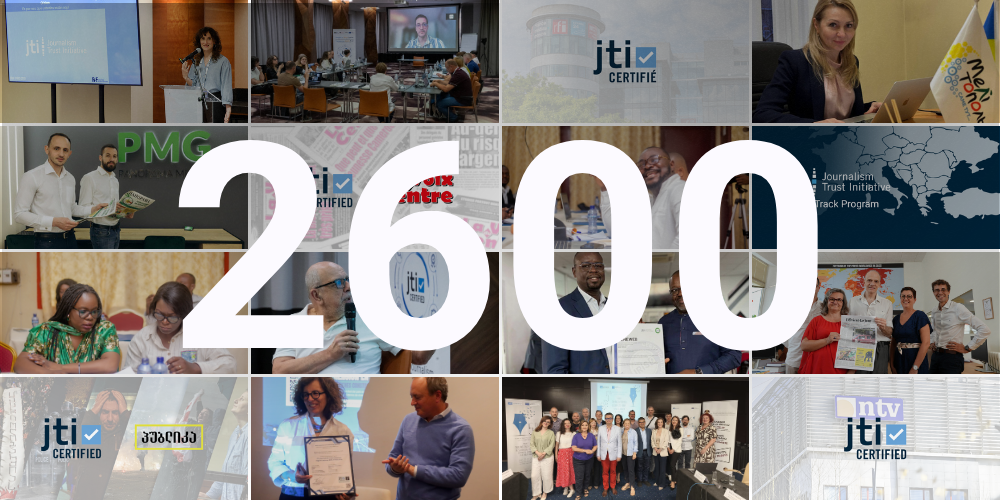
Over 2,600 media in 135 countries use Journalism Trust Initiative (JTI), the international ISO-type standard that promotes trustworthy journalism. Its continued growth reflects the combined efforts of media organisations, local partners, international donors and funders, and JTI’s global network of representatives.
Radio stations, television channels, online news sites and newspapers in 135 countries use JTI to assess their practices with the criteria of the international standard through the JTI Compliance Center. To date, more than 900 media outlets have published their transparency reports, and many have gone on to pursue the JTI certification through an audit conducted by an independent third-party organisation.
“The steady growth of Journalism Trust Initiative reflects a shared commitment from news organisations worldwide to strengthen transparency and reinforce public trust. Every new media outlet joining JTI contributes to building a stronger, more accountable information ecosystem.”
Benjamin Sabbah
Director of Journalism Trust Initiative, Reporters Without Borders
A growing community worldwide
JTI continues to expand across every continent, with media organisations of all sizes strengthening their commitment to transparency and editorial accountability. Recent certifications reflect this global momentum.
In Europe, several Ukrainian newsrooms are progressing towards JTI certification through dedicated Fast Track programmes conducted by local partners. Two additional Fast Track programmes have also recently concluded in the Balkans, further expanding the initiative across the region. Meanwhile, Publika in Georgia recently achieved JTI certification despite a challenging media environment. In Germany, media organisations continue to renew their certifications, including GMX & Web.de, demonstrating their sustained commitment to the standard.
Beyond Europe, NTV Television in Mongolia recently joined the initiative, while Colombia is seeing increased engagement through workshops and webinars supporting local newsrooms. African countries such as Ivory Coast and the Democratic Republic of Congo also continue to expand participation, contributing to a region where more than 300 media organisations have completed the JTI self-assessment by publishing their Transparency Report.
Sustained growth
Projects funded by international donors and implemented with local partners enable JTI to deliver workshops, webinars and tailored mentoring that support local and smaller newsrooms throughout the certification process. At the same time, JTI’s international network of representatives helps expand the initiative by engaging with media organisations year-round and promoting the standard across different regions. Beyond certification itself, these capacity-building initiatives help media organisations strengthen their editorial practices and build lasting transparency and accountability mechanisms.
An ISO-type standard for reliable sources of information
JTI was developed in 2019 as an ISO-type international standard by roughly 130 experts from media outlets, media regulatory bodies, media associations and digital platforms. They worked to define the criteria of transparency, independence and ethics necessary for an industry standard applicable to all types of news sources. The idea of designing a self-regulatory mechanism applicable to all news sources worldwide was the initiative of the Paris-headquartered media freedom watchdog Reporters Without Borders (RSF).
The JTI certification process has three stages. First, the introduction to the standard via JTI’s portal. Second, the self-evaluation by the media. Finally, as an option, the certifying audit.