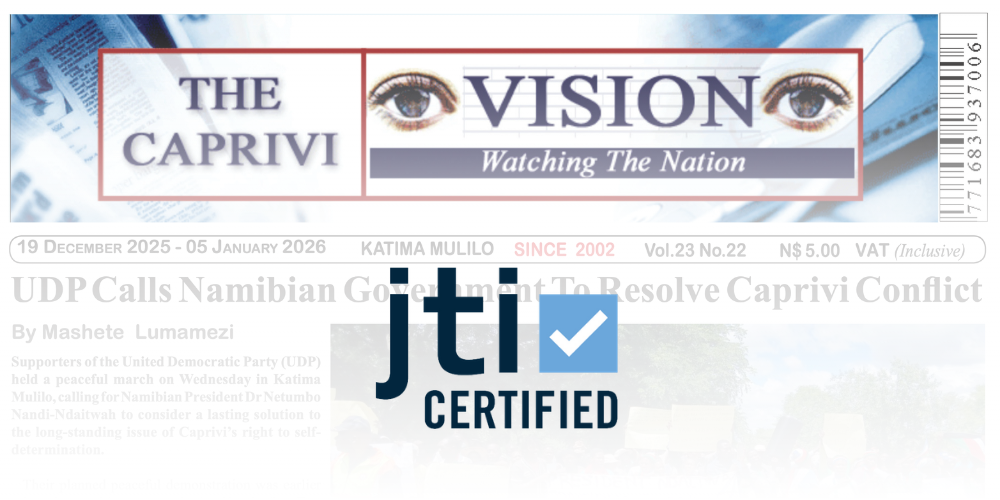
The Caprivi Vision newspaper is the latest media in Africa to achieve Journalism Trust Initiative (JTI) Certification. This marks a milestone for independent journalism in Namibia as the news outlet strengthens transparency, editorial standards and public trust despite challenging media conditions.
“We are pleased to see Journalism Trust Initiative continue to expand across the world, including in Namibia with the certification of The Caprivi Vision. This growing momentum reflects a shared commitment across the industry to reinforce trust in reliable and professional journalism. Congratulations to The Caprivi Vision team for leading by example in the country.”
Benjamin Sabbah, Director of Journalism Trust Initiative, Reporters Without Borders
“Receiving JTI certification is both an honour and a responsibility for The Caprivi Vision. As Namibia’s first JTI-certified community media outlet, it strengthens our commitment to transparent, accurate and accessible journalism that truly serves our communities. We hope this recognition will also encourage other media organisations in Namibia to join the initiative and help build greater trust in journalism across the country.”
Risco Lumamezi, Editor of The Caprivi Vision newspaper
Worrisome Conditions Despite a High Ranking in RSF’s World Press Freedom Index
Freedom of the press remains firmly established in Namibia, which has historically ranked among Africa’s top-performing countries in RSF’s World Press Freedom Index. The country placed 23rd in RSF’s 2026 index, improving from an already strong 28th position the previous year. Despite this sign of progress, the Caprivi Vision newspaper reports growing financial difficulties, while many print media outlets have transitioned to digital formats.
“The Caprivi Vision has faced significant challenges, including financial losses linked to printing outside Namibia and limited resources,” Lumamezi said. “Operationally, we continue to struggle with a shortage of permanent staff — including journalists, marketers, and designers — as well as insufficient printing equipment, computers, and transport. Access to media also remains a challenge, as most major publications are based in Windhoek, leaving rural communities without a dedicated platform.”
Elevating standards of news media
JTI was developed in 2019 as an ISO-type international standard by roughly 130 experts from media outlets, media regulatory bodies, media associations and digital platforms. They worked to define the criteria of transparency, independence and ethics necessary for an industry standard applicable to all types of news sources. The idea of designing a self-regulatory mechanism applicable to all news sources worldwide was the initiative of the Paris-headquartered media freedom watchdog Reporters Without Borders (RSF).
JTI certification is an important driver for strengthening journalistic standards, helping media outlets improve the rigour of their reporting, the management of sources, and the transparency of their practices for the benefit of the public. For The Caprivi Vision, the self-assessment phase proved to be “an eye opener, as it helped evaluate the newspaper’s strengths and weaknesses,” Lumamezi explained. “We have come to understand the importance of having an editorial policy to guide accuracy in news reporting. The JTI process also reinforced the need for accountability and transparency, leaving little room to withhold information.”
More than 2,550 media outlets in 131 countries use JTI. 1,460 are currently undergoing self-assessment, 860 published their transparency report, and 140 obtained JTI certification following an audit. In Namibia, a handful of media outlets are currently involved in the JTI process. Across the continent, more than 800 media outlets in sub-Saharan Africa are currently participating in the JTI process, and around 20 of them have so far obtained their certification, including, most recently, the digital media outlet Ivoire Check in Côte d’Ivoire and La Voix du Centre in Cameroon.