Reporters Without Borders (RSF) concludes a second Journalism Trust Initiative (JTI) Fast Track programme in the Western Balkans and Türkiye, as part of UNESCO’s programme Building Trust in Media in South-East Europe: Support to Journalism as a Public Good. Twenty news outlets received dedicated support from local partners, such as press councils and media experts, to navigate their self-assessment with the requirements of JTI, the international standard for transparent and ethical journalism.
To support the adoption of JTI by news organisations, RSF has launched JTI Fast Track programmes around the world, with recent editions taking place in Ukraine, Guinea-Bissau and the Western Balkans region. Local partners are carefully selected to mentor and support participating media throughout their self-assessment with the JTI criteria. The objective of these capacity-building initiatives is to maximise participants’ compliance with ethical principles, recognised journalistic methods and guarantees of editorial independence.
This second edition, which took place in the first half of 2026, builds on the success of the first Fast Track programme in the Western Balkans and Türkiye, which notably resulted in the first JTI certification in Türkiye for online news outlet Bianet.
This year, 20 media outlets from the region received tailored support from local partners throughout their JTI self-assessment. Participating newsrooms attended dedicated workshops and benefited from individual mentoring designed to help them understand the standard, navigate their self-assessment, and publish their transparency report.
Strengthening cooperation with press councils
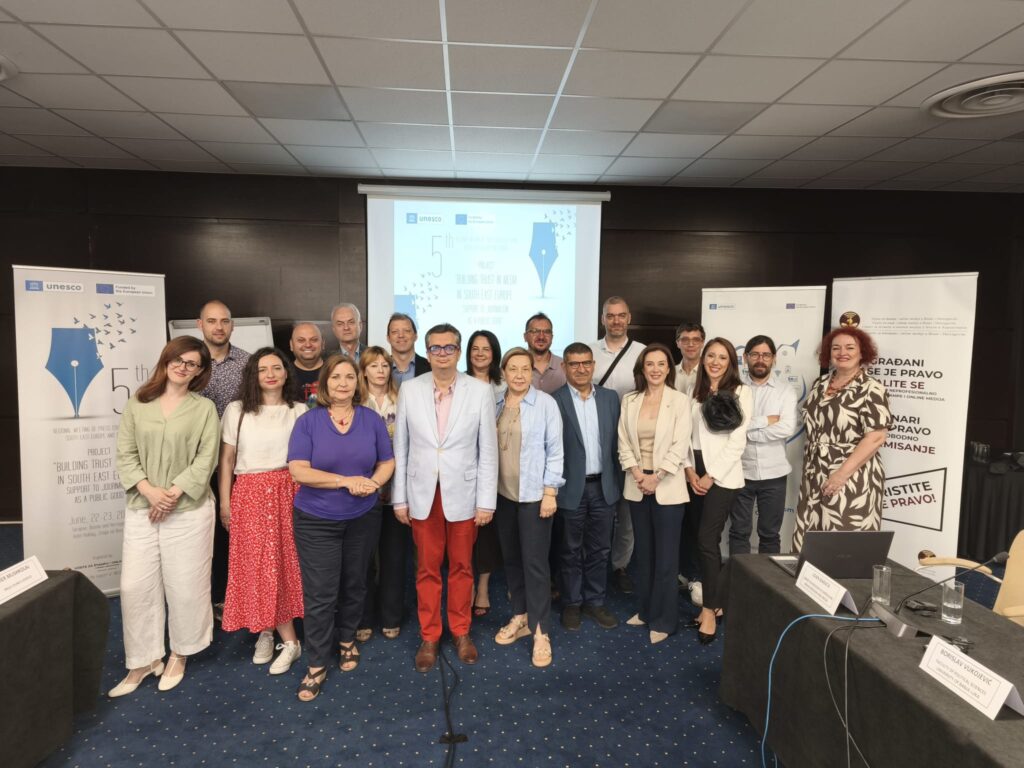
As part of the UNESCO project, RSF also met with representatives of the Turkish Press Council, the Albanian Media Council and the Montenegro Media Council. These exchanges provided valuable insights into the specific characteristics and challenges of the media landscape in each country, helping to inform future project implementation and JTI activities. The meetings were conducted in person by Benjamin Sabbah, Director of the Journalism Trust Initiative, during the regional conference held in Sarajevo from 22 to 24 June 2026.
“JTI offers a very good framework for all media organizations to work with on Ethical issues. AMC is willing to apply the JTI standard to all the members of the Ethical Alliance and also like to see the possibility of including it in the Code of Ethics.”
Koloreto Cukali, Chairman of the Albanian Media Council
“The JTI programme motivated media outlets to work on their own professionalization and on closer adherence to the Journalists’ Ethics Codes in their countries.
For us as a Press Council, it turns self-regulation from a reactive into a capacity-building instrument, and gives member media a transparency credential that strengthens public trust.”
Ranko Vujović, Executive Secretary of the Media Council for Self-Regulation (Montenegro)
An ISO-type standard for reliable sources of information
JTI was developed in 2019 as an ISO-type international standard by roughly 130 experts from media outlets, media regulatory bodies, media associations and digital platforms. They worked to define the criteria of transparency, independence and ethics necessary for an industry standard applicable to all types of news sources. The idea of designing a self-regulatory mechanism applicable to all news sources worldwide was the initiative of the Paris-headquartered media freedom watchdog Reporters Without Borders (RSF).
The JTI certification process has three stages. First, the introduction to the standard via JTI’s portal. Second, the self-evaluation by the media. Finally, as an option, the certifying audit. More than 2,600 media outlets in 135 countries use JTI. Across the Balkans region, more than 160 media organisations are now part of Journalism Trust Initiative.